How to Increase Productivity in a Workplace Through Art
I've heard information technology said that art is a fourth dimension traveler. Information technology's true. Art leaps through history and across continents, through reality and the surreal, moving faster than any motorcar or flight. It's a time traveler who allows us to sit at its windows and visit destinations that awaken, challenge, and inspire.
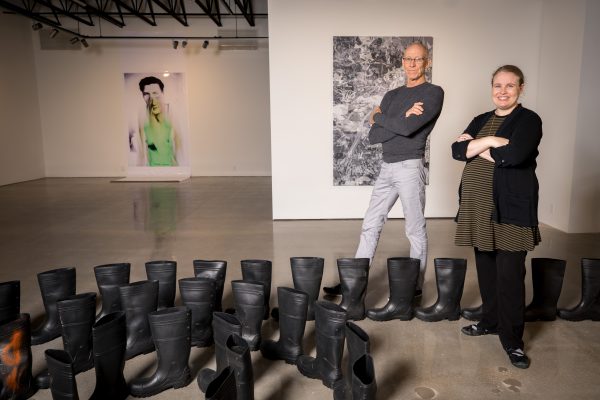
Yet, to telephone call Dr. Greg Metz, senior lecturer at UT Dallas, and inquiry assistant Katrina Saunders bout guides would be an understatement. Dr. Metz, a long-time creative person and curator of Derive Fine art, and Ms. Saunders a designer at Derive Art, are time travelers in their own right, creators of fourth dimension-defying spaces, and researchers who have dedicated their lives to promoting art teaching.
Dr. Metz'southward venture, Derive Art, is an art service that specializes in bringing contemporary artworks to the workplace. As a service, Derive Art provides artwork installations for hire and acquisition, but the goal of Dr. Metz and Ms. Saunders inquiry is more impactful than feng shui. While their multifaceted approach to introduce artwork into the workplace creates a platform for employees to become knowledgeable about art, equally well equally spark interesting conversations about the world effectually them, their work aims to solve an underlying problem that Dr. Metz understands very well.
"We saw a market for change." Dr. Greg Metz
Fuel cost? The artwork has to at least be transported, right?
The dilemma they work to solve is trickier. Their 'research challenge' more importantly focuses on the disconnect between the art market place and larger public audience; thus encouraging a new, more than informed collector base which could reduce the impact that stagnating sales have on the livelihoods of artists.
Dr. Metz shared with us: "The market has been very stagnant and we wanted to figure out how nosotros could create a new model that would stimulate and revitalize an interest in what is going on in the art earth, that can exist both beneficial to both the public and to the artist and the industry."
Several factors affect the market place. Before this year, The Guardian ran an article which examined two major auction houses – Christie'southward and Sotheby's – and gave insight to some of these pressing changes: overhead, court battles, and plush seller-guarantee systems. For those who aren't equally familiar with the art world, express knowledge of art and artists may stall or prohibit an opportunity to invest in artistic pieces; stagnating the art marketplace further.
"We saw a marketplace for alter," Dr. Metz told the states.
With research conducted in Europe, Dr. Metz interests became twofold: he held an interest in expanding the market by introducing artwork into working spaces and was as well curious how changing a working surround could do good employees, the company, and branding.
"Nosotros think that artwork has the power to transform not only a space, just the people who encounter it on a daily basis." Katrina Saunders
To begin, he needed to convince those unfamiliar with art that incorporating it into the workplace would create change, such equally a spark of inventiveness to increase employee engagement and heave productivity. Published concluding year in Gallup, merely 32% of workers in the U.South. were considered to be engaged with or in their jobs. Over the final few years, Forbes has taken note in employee disengagement, particularly in regards to the influence that working environments play in productivity, including examining the deeper effects of artwork on the well-existence of workers. Not simply does the research Dr. Metz and his team conduct contributes to this work identify conversation, just they bring a twist. While workplace inspiration is a hot topic on the internet, a quick Google search reveals a subtle dialogue that Derive Art is tapping into: considering the livelihoods of artists, as workers, too.
For his research, Dr. Metz held initial interviews to solicit employee interests, generate ideas, and examine the organizations infinite. Afterwards mining his inquiry and narrowing down a proposal of artists, Dr. Metz and his team used Photoshop to contain images into the work spaces for a realistic interpretation of how fine art can transform a space.
Art pedagogy also plays a key role in Dr. Metz's fine art selection process. Integrating art into the workplace is likewise a didactic endeavor for Dr. Metz, Ms. Saunders, and their clients. The Derive Art squad familiarizes themselves with the background interests of employees and the overall business civilisation, and introduces them to the functions which art perform, how art is valued, and makes determinations on art selections based on how the organization relates.
Adding depth to Dr. Metz'south research and expansive art cognition, he besides incorporated a model to explore workplace culture. By implementing the Competing Values Framework model, Dr. Metz and his squad expect at the diverse needs the workplace supports. By understanding how role space pattern and other elements such every bit furnishings can play into an organizations civilization, designers Dr. Metz and Katrina Saunders goal is to introduce fine art that challenges and inspires; fine art that stimulates and increases productivity.
"We don't want to put decorator art in to match the couches," Dr. Metz informed us. "We desire it to be challenging, interesting. Nosotros want information technology to be an inquiry, stimulating, creativity."
"[Nosotros] don't await at ourselves as decorators. We don't want to put decorator art in to lucifer the couches, we want it to exist challenging, interesting, nosotros desire it to be an inquiry, stimulating, creativity." Dr. Greg Metz
Later artwork and installations have been initiated into the workplace, Dr. Metz and his team surveys employees to learn how the change affects them. The results are surprising.
"We found that the biggest change," Ms. Saunders said, "[was] increased social date."
Results from the Derive Art survey revealed that 75% of employees had new things to discuss and formed new lines of communication betwixt employees that hadn't existed before. Likewise, an interest in art increased over time amongst workers and the presence of it brought creative stimulation to projects.
"Nosotros think that artwork has the power to transform not only a space, simply the people who encounter it on a daily basis," Ms. Saunders continued. "We believe that people who are with an bodily fine piece of artwork…that their thought will become elevated."
Their research also revealed that artwork habituates later on six months. Once employees have become accustomed to seeing a slice of art, Dr. Metz says, "Nobody sees information technology. It just becomes a blind spot." To keep the atmosphere from stagnating, Dr. Metz'southward squad rotates artwork every six months. With each new piece that is introduced into the environment, the Derive Fine art team is able to gain feedback to gain insight on new artwork to bring into the spaces in the future.
When Dr. Metz and Ms. Saunders are not traveling from galleries and businesses transform lives and workspaces, they each relish partaking in art activities. Both concur it's their history and a deep part of their lives. Dr. Metz also enjoys playing former-timers fast pitch hardball and sailing, exploring art scenes, also equally traveling to the Chianti Mountains and Big Curve. Ms. Saunders engages with connections in the art world here in Dallas, meeting new artists, talking almost their piece of work, and thinking almost the work of new artists in correlation to Derive Fine art.
Like art, they are always on the move, bringing together people and ideas to the windows of new worlds.
mcwilliamswhey1969.blogspot.com
Source: https://research.utdallas.edu/blog/a-market-for-change-art-and-the-workplace

Отправить комментарий for "How to Increase Productivity in a Workplace Through Art"